
This form is for you to be able to get updates, further information and for us to contact you – regarding the action, accommodation and transportation.
Packing List can be found here.
Maps
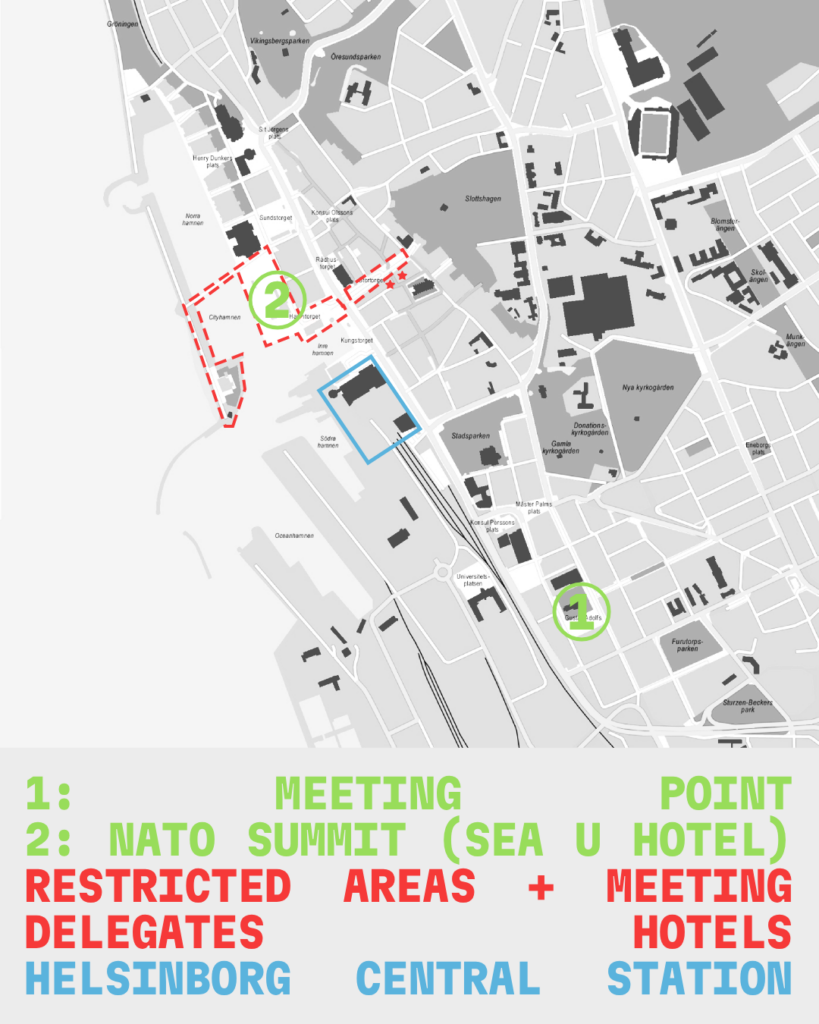
Map 1 – Helsingborg (inner city)
GREEN 1 – Meeting point: Gustav Adolfs torg (Meeting time: 11:00)
GREEN 2 – Sea U Hotel – location of NATO’s meeting
RED – Restricted areas (more about the restrictions on the police’s own website)
RED stars – Other hotels where delegates and officials will stay
BLUE – Helsingborg Central Station
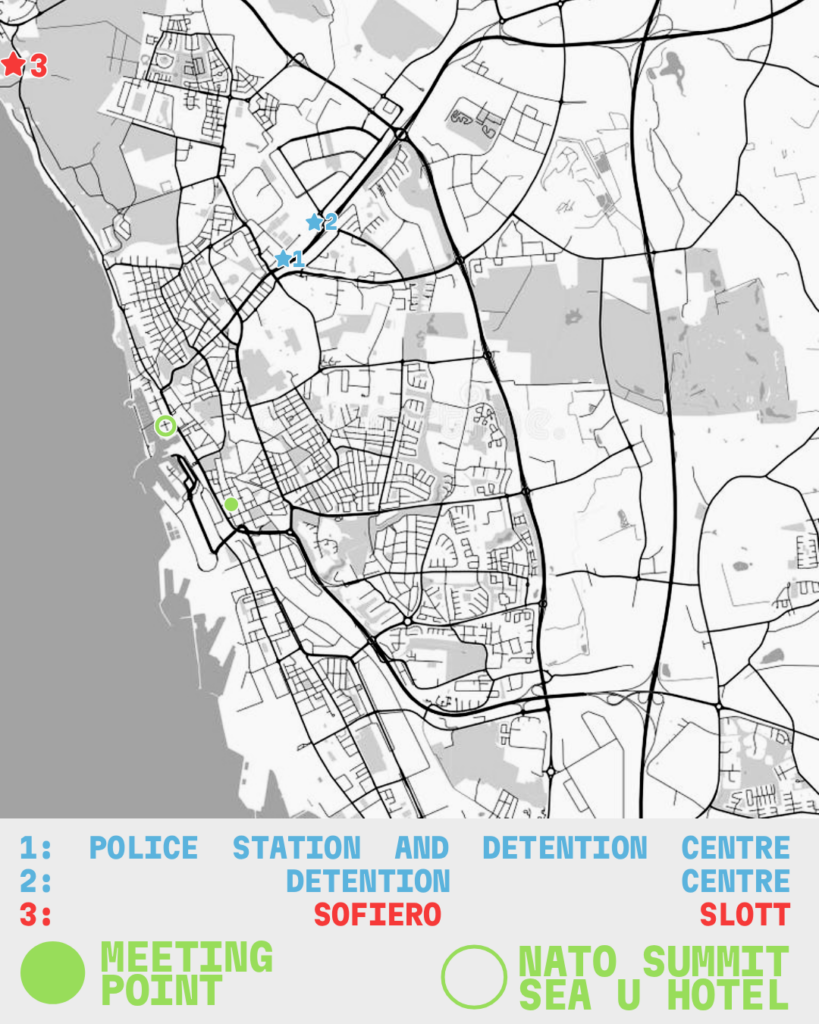
Map 2 – Helsingborg and surrondings
BLUE star 1 – Police Station and Detention Centre (Berga allé 25 and Berga allé 21)
BLUE star 2 – Detention Centre (Bergavägen 1)
RED star 3 – Sofiero Slott
How we keep our community safe through anonymity
Masking
How/when to mask on: It is best to mask up collectively, many people need to do it together so individuals cannot be singled out. If it is impossible to mask on safely during a gathering then it can be done as a demo is moving. Masking is done best when completely obscured from cops or cameras, and through changing as many clothes as possible. Use your affinity group for cover.
Preferably, change from an “innocent” look into your demo-clothes (completely black). Remember to use tape over visible symbols, such as logos.
“Soft” masking through using caps and/or sunglasses is legal and obscures cameras and filming to a great extent. This can be very helpful before a demo, or if it is impossible to mask completely due to repression.
How/when to mask off: Mask off as soon as a demo is dispersing, go out of sight, get rid of the masks and leave. An affinity group can cover each member in turn as it occurs.
Staying anonymous
Use an action name.
If you are not bringing ID – remember to go through your pockets before the action and remove everything in them that can identify you.
Remember not to talk or brag about what you or any of your comrades may or may not have done at the demonstration in public spaces.
Don’t talk to cops
Police at demonstrations are there because they are on duty. When they talk to you it is not because they are genuinely interested, but because they are doing a job whose purpose is to counter demonstrations. Even seemingly innocuous questions like “Have you traveled far today?” are meant to map where a person comes from and to gather evidence. Having attended a demonstration links the individual to a potential intent, for example, which could be used in a trial. Such questions also serve to identify who is more hostile toward the police (and therefore who should be monitored more closely). Police are skillful, and can one moment appear to sympathize with your cause and the next try to suppress you. For that reason, do not speak to the cops unless it is strictly necessary.
Dialogue police
The dialogue police’s work, according to the police’s own governing documents and doctrine, is to be the police’s eyes and ears, and a “soft” power the police use before they deploy force. The dialogue police try to gather information about demonstrations and demonstrators before and after events in order to map which groups they can control with dialogue and which groups the police prepare to use force against. During demonstrations the dialogue police spend time mapping moods. The term “dialogue” is misleading: the dialogue police have very little mandate to decide anything themselves. Decisions are made by the incident command. However, the dialogue police often try to make it appear as if they have a lot of influence. The interventions at the Revolutionary First of May this year in Malmö made it clear the dialogue police lack power and/or lie. In other words, the dialogue police are yet another tool of the state. Do not talk to them. Do not give them information. Tell others who try to engage with them the same.
How we keep our community safe through solidarity
Solidarity is our weapon. We act together and we support one another. That means that showing empathy and aid between protestors is one of the most important things we can do. If someone is targeted by cops – find ways to support them. If someone seems upset, speak to them. We never use sexist, racist, etc. language against our enemies because it will divide us internally as well. We help people who fall, guide those who might feel panicked, and we do not engage in any machismo that might push people to do things they are actually not comfortable with.
Moving and sticking together
Be aware at all times of the flow of the protest and your own closest affinity group. Ensure that no big holes appear in the demo. Keep a lookout on your surroundings and the movement of the police. Form chains with your arms if need be, but also be ready to flow around police instead and make such decisions quick and fast. If people fall behind, try to get them to hurry up or, if there is some reason why they cannot keep up, have the demo move slower. If that is not possible, then it might be necessary to leave stragglers behind.
Communication
Remember to believe your comrades – not the cops.
Rumors spread quickly in stressful situations – that is why its important that we are transparent with each other and communicate only…
Solidarity work
The demonstration will have arrest support and solidarity work. If someone is arrested, we organize outside the police station, we collectively make sure everyone is helped legally, socially and economically.
Remember to write up the arrest support number on your body with a water resistant pen – and double check that every one in your affinity group and the people around you does the same.
The arrest support number will be posted on our social media.